
Omaha Family Resource Center:
The BRIDGE on Hope Champions Podcast
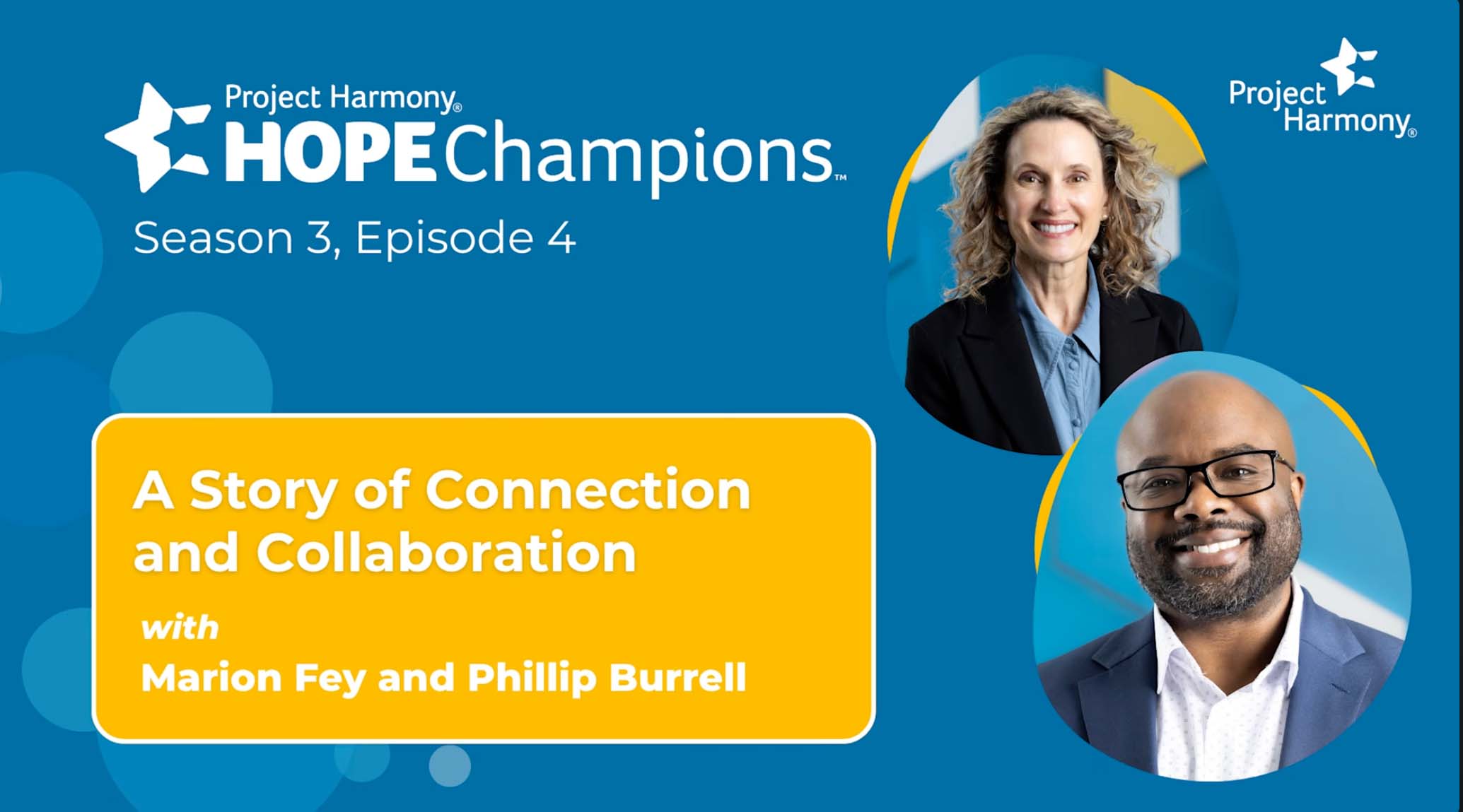
No Wrong Door: How One Omaha Family Resource Center Is Building Hope
What does it take to help a family before a hard season turns into a crisis? Our executive director, Marian Fey, and our senior director of programs, Phillip Burrell, explored that question when they joined Mandy Suing of Project Harmony on the Hope Champions podcast.
In under half an hour, they covered how an Omaha family resource center works, why a “warm handoff” matters, and what young adults in Project Everlast do with their own stories. You can [watch the full episode on YouTube](YOUTUBE LINK). Here are the highlights.
Meet the BRIDGE: an Omaha family resource center built on prevention
The BRIDGE Family Resource Connector Network is a young organization. Our board incorporated us in 2022. Marian started in early 2023, Phillip joined that March, and the team was fully staffed by July 2024.
Our focus is prevention. We work to keep families out of the juvenile justice and child welfare systems by connecting them to the right help early. We do that with three strategies:
- Central navigation. A “no wrong door” approach that connects families to the resources they need, with warm handoffs to the right people at the right time.
- Youth and family leadership. Ways to lift the voices of the people most affected by services in our community.
- Community collaborative. A table where education partners, policymakers, funders, and nonprofits solve problems that are too big for any one group.
What an Omaha family resource center does every day
Nobody can be expected to know every resource in town. That is why six full-time navigators on our team learn what is out there and match each family to help that fits their needs and their part of the city. When a navigator does not have the answer, they know someone who does.
The requests we hear most are about basics. Housing is number one, followed by utilities such as OPPD and MUD bills. Transportation comes third. That order has held steady for the past few years.
The warm handoff is what sets this work apart. A navigator calls the partner organization ahead of time and explains the situation. Then the family learns exactly who to ask for, what to expect, and about how long the wait might be. That small step makes a new place feel far less intimidating.
The relationship continues, too. A family or young person can return to the same navigator as many times as they need. You are not calling a call center. You are working with a real person.
The network makes it possible. In 2025, our navigators connected families to more than 400 organizations and programs across Douglas County. Each month, 75 to 85 people from dozens of partner organizations join our resource group, which meets the first Tuesday at 9 a.m., in person and online, to share what programs are funded and where help is available.
How four organizations kept one family housed
Phillip shared a story that shows why the network matters.
A client came to us after losing a job. They had been paying rent with their tax refund while they searched for work. Then a delay hit. By the time they found a new job, they owed about $1,500 in back rent. That is a hard hole to dig out of, even for someone who is working.
It is also a lot for any one organization to cover. So we worked with about four partners to pool the funds and keep this person in their home. We also built a sustainability plan to make the same situation less likely down the road.
“We are a preventative organization,” Phillip said, “so anytime we can help people stay in a safe and stable environment, that is what we want to do.” When a family has to move, children may change schools and the bus route to work may disappear. Stopping the first domino is the point.
Project Everlast: young adults who reach back
Project Everlast began in 2007 as a program of Nebraska Children and Families Foundation, started by young people who wanted to make foster care better for those who came after them. It became part of the BRIDGE in 2024, and it has its original home at our Omaha family resource center.
Today, Everlast serves young adults ages 14 to 26. It once focused on youth with foster care experience. Now it also welcomes young adults who were never wards of the state but did not have the support at home they needed.
Each month, there are three gatherings:
- A social event. A safe place to meet other young people and build relationships that do not depend on caseworkers.
- A hands-on activity. Learn to do taxes, build a budget, or cook. Or experience Jazz on the Green for the first time.
- A leadership session. Practice advocating for others and leading in the community.
Many go further. Some take storytelling training that teaches them to share their experiences without retraumatizing themselves or their audience. Then they speak out so the next generation faces fewer of the same hurdles.
“I think those are our biggest success stories,” Phillip said. “Those young adults that not only get on their feet, but then they reach their hand back to help someone else out.”
Family-led means families have a seat at the table
Everything families and young people do through the BRIDGE is voluntary. No one is sent by a court, nothing is mandated, and there is no 90-minute assessment. We do not prescribe solutions. Families who visit our Omaha family resource center set their own goals, and a navigator helps them build the roadmap.
The same principle shapes how we run the organization. When we wrote our new mission, vision, and values, we took them to our parent leaders every month and asked what to change. “Relationships first” is now one of our values. “We don’t want token representation,” Phillip said. “We want true representation.”
We also share what we know. Each year we offer free community trainings in Youth and Families Thrive and motivational interviewing, and for the past two years, one on education rights. Parent and youth leaders attend with a stipend. “We don’t ever want to be the keeper of all the things,” Marian said. The goal is a deeper bench of people with lived experience who advocate for other families and youth.
What comes next: 24-hour access to navigators
We are working with the Nebraska Department of Health and Human Services to carry out LB 48, a bill introduced by Sen. Terrell McKinney and passed in 2025. It will give families 24-hour access to skilled navigators at a new center. Partners will offer mental and behavioral health care, physical health care, job skills, mentoring, and tutoring, and some emergency shelter will be available as well.
When we recorded the episode, we hoped to have everything running by fall. It adds another pathway to our “no wrong door” system, and we will share updates as the work moves forward.
Where to find our Omaha family resource center
If you are looking for an Omaha family resource center and wondering whether to reach out, our answer is simple: do not overthink it. Our Director of Central Navigation often interrupts a partner’s question with, “Just send them. We will figure it out.”
Here is how to connect:
- Walk in: 314 S. 26th Street, Omaha. Monday through Friday, 9 a.m. to noon and 1 to 4 p.m. Call ahead to make an appointment outside walk-in hours.
- Call: (402) 384-4670
- Go online: Fill out our intake form.
- Ask a partner: If you already work with another organization, they can connect you to us. You do not have to start over or leave something that is working.
You also do not need to wait for a crisis. Our navigators have connected young adults to job-skills training at Metropolitan Community College, helped with apartment applications, and reviewed resumes. Coaching is also available through partner organizations for people ready to build savings or work toward financial stability.
Mandy shared a line her CEO at Project Harmony likes: everything is figureoutable. We think that fits. Thank you to Project Harmony for the invitation and for being a steady partner to this community.
As Mandy said to close the episode, hope grows when we share it.
Listen to the podcast episode on YouTube … then pass it along to someone who might need it.